

Fast Rods!!
Over the last couple decades, fly rods got faster.
Lighter materials, stiffer blanks, higher line speed. For a stretch there, it felt like every manufacturer was racing to build the fastest rod on the planet. And they won. They just didn’t think too hard about who was going to fish them.
Fast rods aren’t bad. In recent decades, advances in materials, design, and manufacturing techniques have resulted in fly rods that are lighter, more responsive, and faster in terms of action. But for the average fly fisherman, especially those still honing their casting skills, fast rods can feel twitchy or unforgiving. They require more precise timing and technique to load properly. Miss that window and the rod feels like it isn’t bending at all.
That’s where the confusion starts.
Most real-world fishing shots happen between 40 and 60 feet. At those distances, many fast rods don’t fully load with true-to-standard lines. When the rod doesn’t bend, it feels lifeless. Most anglers blame themselves.
Often, it’s the setup.
What Does It Mean to Load a Fly Rod?
Loading a fly rod refers to bending or flexing the rod when you cast. The energy stored in that bend helps propel the fly line forward when you release it. The more the rod loads, the farther and more accurately you can cast.
Fast rods load quickly with a short, sharp bend near the tip and release that energy in a split second. Medium-fast rods take more time to load and bend farther down the blank, giving you time to feel the load and make a smoother cast. They offer a better balance between power and control and are easier to use for most anglers across a wider range of conditions.
Neither is right or wrong. They just behave differently.
Two Real-Life Lessons with Fast Rods
The anglers drew straws to determine who would have to fish with a particular member that no one wanted as their partner. They said he was a terrible caster and couldn’t throw it 30 feet. It was the evening of the last day of a six-day trip, and he was practicing his cast on the beach in front of the lodge. I was sitting on the porch, sipping a rum and coke, wondering if he was going to get voted off the island. I watched him struggling with his cast. It wasn’t that bad. His rod was rigged with the line weight recommended by the manufacturer, but it wasn’t bending or loading, and it wasn’t going anywhere.
I walked over and asked if I could cast his rod. I couldn’t throw it much further than he could. It was like trying to cast with a kite string; there was no load. I grabbed a reel spooled with line one weight heavier and put it on his rod.
The rod transformed into a cannon, doubling his casting distance. It was cathartic; he went from despair to elation after just a few casts. I felt so bad that he had been fishing with an underlined rod all week that I gave him the new line. It was my pleasure.
One more story.
During a bonefishing trip, a friend brought down prototypes from a major manufacturer for testing. While on deck, I spotted a big tailing bonefish straight away into a stiff 20 mph wind. Using the latest and greatest model rod, I made three casts but fell short each time. Frustrated, I muttered a few choice words. Unsolicited, the guide noted that the line seemed too light for the rod and wasn’t loading correctly. It wasn’t bending. My friend who brought the rods casually mentioned, “Oh yeah, you gotta over-line these rods by a weight.” Once I switched to a heavier line, the rod performed as expected.
If you’re struggling to feel your rod load, over-lining by one weight might change your world. Think of it like this: would you rather throw a wiffle ball into the wind or a baseball? Which one goes farther?
An Analogy for Golfers
Some golfers insist on buying stiff-flex clubs because they are a manly man. They hit a pitching wedge 100 yards. Why? Because they don’t generate the swing speed needed to flex a stiff club properly. A regular flex club with the same swing speed would hit that ball 120 yards. Same with a fast fly rod. It won’t load if you can’t flex it.
How the Industry Got Here
When I first wrote about this topic, most fly line makers stuck to industry standards. Then RIO decided to build heavier lines. Anglers wanted lines that loaded rods more easily under real fishing conditions, especially in wind. Sales exploded. What customers didn’t realize was that they were unintentionally over-lining their rods. The rest of the industry eventually followed.
Rod labels didn’t change. Line labels didn’t change. Grain weights did.
That’s why many anglers today aren’t sure what they actually have in their hand or what line to buy to go with it.
Grain Weights Matter More Than the Label
Fly line weight is determined by the weight of the first 30 feet of line. According to AFFTA standards:
| Line Weight | Grains (30 ft) |
|---|---|
| 7 wt | 185 |
| 8 wt | 210 |
| 9 wt | 240 |
| 10 wt | 280 |
| 11 wt | 330 |
| 12 wt | 380 |
Manufacturers have blurred these standards by lengthening heads and shifting weight distribution forward. The number on the box doesn’t always tell the whole story. The grain weight does.
RIO Lines
| Line | 30 ft Head | Notes |
|---|---|---|
| 9 wt Flats Pro Elite | 280 grains | Equivalent to a traditional 10 wt. Total head 400 grains at 50 ft. |
| 9 wt Bonefish Quickshooter | 300 grains | Great for short quick casts. Lands hard at distance, can spook fish. |
| 9 wt Bonefish Elite | 260 grains | Half size heavy. Total head 369 grains at 49.5 ft. |
SA Lines
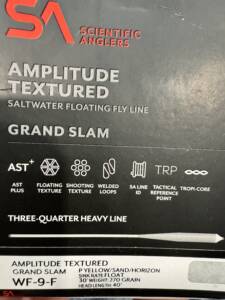
SA was one of the last to increase grain weights. To their credit, they now clearly label when a line is overweighted right on the box. That’s how it should be done.
| Line | 30 ft Head | Notes |
|---|---|---|
| 9 wt Amplitude Grand Slam (¾ heavy) | 270 grains | Total head 335 grains at 40 ft. |
| 9 wt Amplitude Bonefish (true to weight) | 240 grains | What it says it is. |
| 9 wt Amplitude Bonefish Plus (½ heavy) | 259 grains | Total head 365 grains at 50.5 ft. |
Over-Lining vs. Overloading
Over-lining is choosing a line slightly heavier than the rod’s designated weight, typically 30–60 grains heavier than AFFTA standard. It slows down a fast rod and makes it easier to feel the load.
Overloading is going too far. Put a 10 wt line on a 2 wt rod and it’s useless and risks breaking the rod.
Rule of thumb: 30–60 grains heavier than standard is a safe window. Past that, you’re changing the rod’s personality in ways that hurt more than they help.
Simplifying the Confusion
Exact distances vary depending on rod model, line taper, and caster, but these guidelines hold up in real-world conditions.
20–50 ft — Fast rods absolutely benefit from a heavier line at short range. They struggle to load fully with standard weight lines at these distances.
50–60 ft — Still well within the range where additional grain weight helps most anglers.
60–80 ft — Gray area. Advanced casters can manage true-weight lines, but a slight increase of half a size can help.
80+ ft — If you’re fishing consistently at this distance, you’ve got the skills. Over-lining at this range hurts more than it helps. Stick with standard weight to maintain loop speed and carry.
If you’re a novice, do yourself a favor and get a medium-fast rod with the recommended line weight. You’ll like it a lot more and save $500–600 in the process.
Final Thoughts
Most anglers are already over-lining and don’t know it, even the “experts.” They grab a line that says 9 wt on the box, disregard the grain weight of 10.5 wt, and assume it’s standard.
Expert casters designed those fast rods to work with precise timing and lighter loads. Most anglers don’t fish that way, and there’s nothing wrong with that. A heavier line amplifies the load and makes it easier to feel and cast at the distances most of us actually fish.
If you have a fast rod and hate how it casts, over-line it by a weight. Once your casting improves, go back down. You’ll have a more enjoyable trip and a better shot at the fish of a lifetime.